Liam’s injury has recurred; should Hope choose another man? The Bold and the Beautiful Spoilers

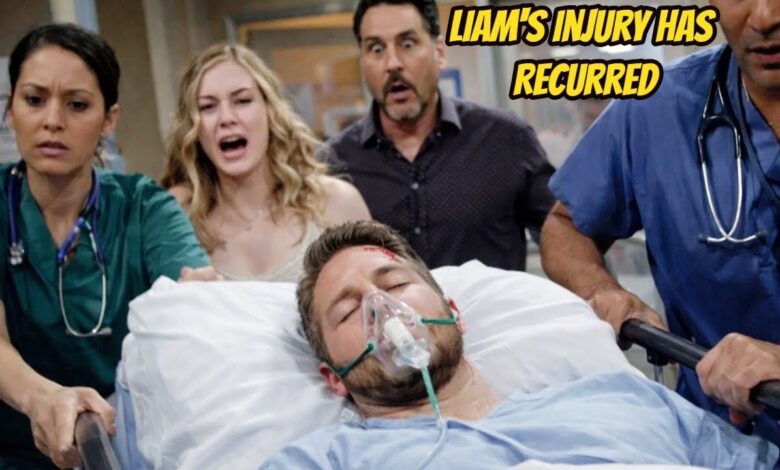
Liam’s Injury Returns: Should Hope Choose Another Man on The Bold and the Beautiful?
On The Bold and the Beautiful, trauma is never a closed chapter. It lingers, resurfaces, and reshapes lives long after the initial wound appears to heal. That painful truth comes into devastating focus when Liam Spencer’s long-buried injuries—both physical and psychological—return with cruel force, raising a heartbreaking question no one is prepared to answer: should Hope Logan eventually choose another man?
The chain reaction begins with the reappearance of Luna Nozzawa, hiding behind the carefully crafted identity of Dylan. Her return is quiet, almost unremarkable on the surface, yet for Liam, her presence detonates everything he has worked so hard to suppress. He recognizes it instantly—not with logic, but with instinct. Her eyes. Her voice. The way she inhabits a room without apology.
Liam’s body reacts before his mind can catch up. Panic sets in. Breath shortens. Memories surge forward—of the shooting, the fear, the helpless realization that his life nearly ended at the hands of someone whose obsession knew no limits. He is no longer grounded in the present. He is trapped in a past that never truly released him.
As Luna settles into her disguise, Liam begins to unravel. Panic attacks strike without warning. Sleep becomes a battlefield of nightmares that replay and distort his trauma. Each morning, he wakes exhausted, carrying invisible scars that refuse to fade.
Hope notices the change immediately. The man she knows becomes distant, guarded, and emotionally unreachable. Conversations end abruptly. Comfort turns tense. Where there was once warmth, there is silence. Hope senses not stress, but fear—deep, specific, and consuming.
Liam pushes her away not out of lack of love, but shame. He believes he should be stronger by now, immune to the past. Admitting the depth of his fear feels like failure. In trying to protect Hope, he unknowingly wounds her, leaving her isolated and searching for answers.
Those answers come slowly. Fragmented confessions. Half-spoken truths. Until Liam finally admits the unthinkable—Dylan terrifies him. That revelation ignites Hope’s determination. She begins watching Dylan closely, noticing inconsistencies, moments when the mask slips. Her instincts, sharpened by years of navigating deception, refuse to be ignored.
What Hope uncovers is chilling. Dylan is not merely connected to Luna Nozzawa. She is Luna. Her return is no accident. It is deliberate, calculated, and dangerous.
The confrontation between Hope and Luna is controlled but explosive. Luna’s confession is not remorseful. It is obsessive. She frames her actions as unfinished business, even a twisted bond with Liam. To Hope, the truth is nauseating. Luna does not see the trauma she caused as damage—she sees it as connection.
Liam’s eventual confrontation with Luna is raw and devastating. He speaks openly of his pain, not as memory, but as a wound still bleeding. Healing does not come easily. It demands vulnerability, endurance, and the acceptance that survival is not the same as recovery.
Hope becomes Liam’s anchor. She listens. She stays. She refuses to rush his healing or diminish his pain. Their relationship transforms—not into perfection, but into honesty forged through suffering.
Just when it seems they have endured the worst, a new truth arrives—quietly, medically, and without spectacle. Liam’s injuries have progressed beyond treatment. His condition is terminal.
For Hope, the diagnosis does not explode. It empties her. Liam, by contrast, meets it with terrifying clarity. If he cannot control his fate, he will at least shape what remains. He begins preparing—not just for death, but for Hope’s life after him.
And it is Liam who asks the question no one else dares to voice: should Hope someday love another man?
He does not ask out of despair, but love. He refuses to let his death become the axis around which Hope’s future collapses. Loving a dying man, he knows, can consume the living.
Hope’s internal conflict is unbearable. Loyalty tells her that even imagining another love is betrayal. Identity tells her she is Liam’s wife, his partner until the end. Yet a quieter voice whispers that she is still alive—that wanting connection in a future without Liam does not erase what they have shared.
She hates herself for hearing that voice.
As family and friends weigh in—some romanticizing lifelong devotion, others urging her not to lose herself—Hope feels judged from every angle. The question is not moral. It is existential. Who is she allowed to be after loss?
Liam, sensing her struggle, insists that love is not finite. That what they share will not disappear if she loves again. Yet even he fears being forgotten. Their final chapter becomes defined by paradox—loving fiercely while slowly letting go.
Hope ultimately understands something profound: choosing life later does not mean abandoning love now. Staying with Liam until the end does not preclude a future beyond him. The two truths can coexist.
Her answer is not a decision, but a promise—to herself and to Liam. She will not seek love to escape grief, nor reject it out of loyalty to pain. She will allow life to meet her when it does, without shame.
In the world of The Bold and the Beautiful, this storyline transcends romance and tragedy. It becomes a meditation on love’s final test—not whether it can survive betrayal or obsession, but whether it can survive mortality itself.
And in that test, Hope and Liam prove that love does not end when life does. It simply changes form.